

GET ACCESS TO OUR AMAZING BLOG DIRECT TO YOUR INBOX
Get industry updates, tips, guides, training documents, white papers and much more direct to your inbox.
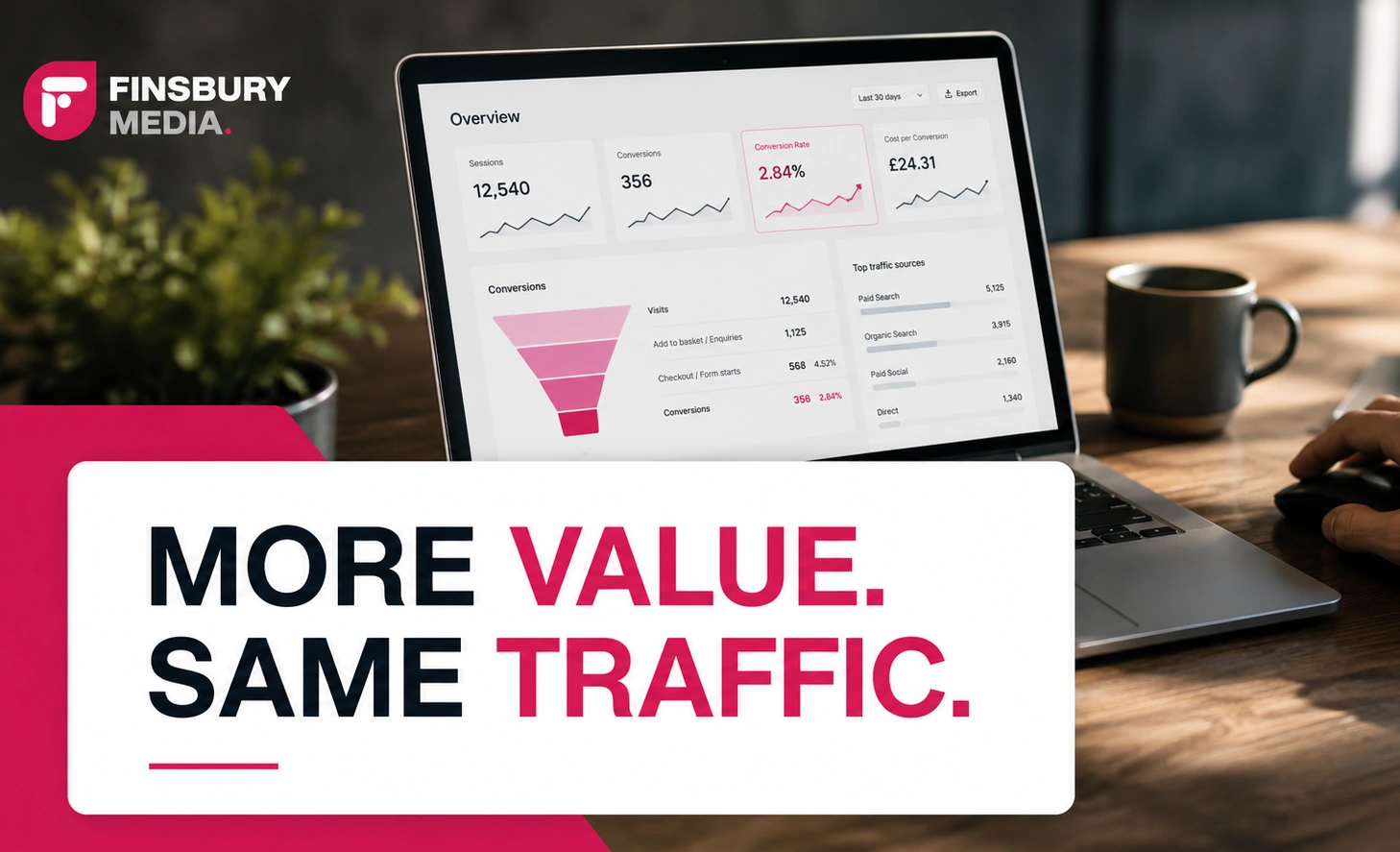
When a business wants more leads or sales, increasing the advertising budget can feel like the obvious solution.
If £2,000 in monthly advertising spend generates a certain number of enquiries, surely spending £3,000 should generate more.
Sometimes it will.
But increasing spend is not always the most efficient way to grow.
Before putting more money into Google Ads, paid social or another acquisition channel, businesses should ask a different question: are we getting enough value from the traffic we already pay for?
If hundreds or thousands of people are reaching your website every month but only a small percentage take the next step, the biggest opportunity may not be generating more traffic. It may be improving what happens after people arrive.
That is where conversion rate optimisation becomes valuable.
What Is Conversion Rate Optimisation?
Conversion rate optimisation, often shortened to CRO, is the process of improving the percentage of website visitors who complete a valuable action.
What counts as a conversion depends on the business.
For a professional services company, it might be submitting an enquiry form or booking a consultation.
For a local business, it could be making a phone call.
For an ecommerce website, it is more likely to be completing a purchase.
The purpose of conversion optimisation is not simply to persuade more people to click a button. It is to understand what prevents suitable prospects from taking action and then improve the experience around those barriers.
That can involve the website’s messaging, layout, forms, calls to action, page speed, trust signals, landing pages and even the quality of the traffic being sent to the website.
Done properly, CRO connects marketing activity with what actually happens after somebody clicks.
Why More Traffic Is Not Always the Answer
Consider two businesses running advertising campaigns.
Both receive 2,000 website visits each month.
The first converts 2% of those visitors into enquiries, generating 40 leads.
The second converts 4%, generating 80.
The second business generates twice as many enquiries from exactly the same amount of traffic.
If the first business simply increases its advertising budget, it may generate more leads, but it is also paying to send additional visitors through an inefficient conversion journey.
Improving the conversion rate first can change the economics of the entire campaign.
This does not mean businesses should stop investing in advertising. It means acquisition and conversion should be considered together.
There is little value in continuously increasing the amount of water entering a bucket if there are holes in the bottom.
Start With the Quality of Your Traffic
Not every conversion problem starts with the website.
Sometimes the wrong people are being sent there in the first place.
A Google Ads campaign targeting broad or poorly matched searches may generate plenty of visitors who were never likely to become customers.
A paid social campaign may attract attention without reaching people who have genuine buying intent.
SEO content can experience the same problem if it generates large amounts of informational traffic that has little connection to the company’s commercial offering.
Before changing landing pages, businesses should therefore understand where their traffic is coming from and what those visitors were looking for.
Useful questions include:
- Are visitors arriving from relevant search terms?
- Are advertising campaigns targeting the right locations?
- Do the advert and landing page make the same promise?
- Are certain campaigns producing substantially better leads than others?
- Which channels generate customers rather than simply clicks?
Finsbury Media’s Conversion Optimisation Platform takes this type of approach by connecting conversion activity with campaigns, keywords, audiences and advertising channels. Rather than treating every click equally, optimisation becomes more valuable when businesses can identify which activity is actually producing profitable outcomes.
Getting more conversions starts with attracting the right potential customers.
Make Sure the Landing Page Matches the Advert
One of the fastest ways to waste advertising spend is to create a disconnect between an advert and the page somebody reaches after clicking it.
Imagine searching for emergency commercial plumbing services.
You click an advert specifically mentioning emergency commercial plumbing and arrive on the company’s general homepage, where you need to search through menus and service pages to find the information you wanted.
The advert may have done its job perfectly.
The landing experience has created unnecessary friction.
A strong landing page should continue the conversation started by the advertisement.
If the advert promotes a particular service, the page should clearly discuss that service.
If the advert highlights a particular benefit, the visitor should see evidence of that benefit when they arrive.
If the advert encourages somebody to request a quotation, that action should be obvious on the page.
The smaller the gap between expectation and experience, the easier it becomes for a potential customer to move forward.
Make the Value Proposition Immediately Clear
Visitors rarely arrive on a business website with unlimited patience.
They want to understand what the company does, whether it can solve their problem and what they should do next.
If that information is buried underneath vague headlines or lengthy introductions, potential customers can leave before discovering what makes the business relevant.
A strong landing page should quickly communicate three things:
- What does the business provide?
- Who is it for?
- Why should the visitor consider this company?
That does not require aggressive sales language.
Clarity is usually more persuasive than exaggerated claims.
Compare a generic headline such as:
“Solutions Designed for Your Future” with:
“Commercial Solar Installation for UK Businesses”
The second may sound less creative, but somebody arriving from a relevant advertisement immediately understands where they are.
Good conversion optimisation often involves removing uncertainty rather than adding more marketing language.
Give Visitors a Clear Next Step
Some websites provide plenty of information but never make the next action obvious.
A potential customer reaches the end of a service page and has to decide for themselves what to do.
- Should they call?
- Complete a form?
- Request a quotation?
- Book a consultation?
- Download something?
A clear call to action removes that uncertainty.
The best CTA depends on what somebody is realistically ready to do at that point in the journey.
A visitor researching a high-value B2B service may not be ready to “Buy Now”. They may be comfortable requesting a consultation or speaking to a specialist.
Someone looking for an emergency local service may simply want a prominent telephone number.
The call to action should match both the service and the level of intent.
Businesses should also avoid presenting too many competing actions at once. Giving visitors six different options can make the page feel flexible, but it can also create unnecessary choice.
Often, one strong primary action supported by a sensible secondary option is enough.
Reduce Unnecessary Form Friction
Forms are one of the most common places for potential customers to abandon a website.
Businesses naturally want information about a new enquiry.
The sales team may want a full name, telephone number, company, job title, turnover, budget, project type, preferred start date and several other details before contacting the prospect.
From the visitor’s perspective, that can feel like a significant commitment.
Every additional field creates another small reason not to complete the form.
This does not mean every form needs to contain only a name and email address. The correct length depends on the business and the type of enquiry.
A company selling a complex high-value service may genuinely need more information to qualify a prospect.
The important question is whether every field is necessary at that particular stage.
Information that can easily be collected during the first sales conversation may not need to become a barrier to the initial enquiry.
Build Trust Before Asking for Action
Visitors arriving from advertising may have never heard of your business before.
You know the company is credible.
They do not.
Before handing over contact details or making a purchase, people naturally look for evidence that they can trust the organisation.
That evidence can take several forms.
- Customer reviews can show that other people have had a positive experience.
- Case studies can demonstrate how the company solved similar problems.
- Accreditations and industry memberships can provide reassurance in sectors where credentials matter.
- Clear contact information, genuine team details and a professional website can all reduce uncertainty.
The strongest trust signals are specific and relevant.
Saying “we provide excellent customer service” is a claim the company makes about itself.
Showing detailed customer feedback or a meaningful case study provides evidence.
Conversion optimisation is often about answering the questions somebody has before they have to ask them.
Mobile Conversion Cannot Be an Afterthought
A website can look excellent on a desktop monitor and still create a frustrating experience on a phone.
Small buttons, awkward navigation, slow-loading images, oversized pop-ups and long forms become much more noticeable on a smaller screen.
That matters because potential customers do not wait until they are sitting at a desk to research a business.
They search while travelling, between meetings, at home and whenever a need arises.
A mobile visitor should be able to understand the page, navigate it and complete the main conversion action without unnecessary effort.
This is why effective web design should consider conversion from the beginning rather than treating appearance as the only objective. A website needs to communicate the brand effectively, but it also needs to make it straightforward for visitors to become customers.
A visually impressive website that makes enquiries difficult is not performing its commercial role.
Improve Website Speed and Remove Distractions
Every extra moment of friction gives visitors another opportunity to leave.
Slow-loading pages are an obvious example, but friction appears in other ways too.
- A page may contain intrusive pop-ups before somebody has had a chance to read the content.
- Navigation may be unnecessarily complicated.
- Important information might sit behind multiple clicks.
- The page may contain animations and visual effects that look impressive but make it harder to focus on the actual message.
Conversion-focused websites do not need to be plain.
They need to be purposeful.
Every major element should support the user’s understanding or help them progress through the journey.
If something distracts from that objective without adding genuine value, it is worth questioning whether it needs to be there.
Use Conversion Tracking to Understand What Actually Works
You cannot improve what you cannot measure accurately.
A business may know it received 50 enquiries this month, but that number alone does not reveal which marketing activity produced them.
Good conversion tracking should help answer more useful questions.
- Which campaign generated the enquiry?
- Which keyword or audience was responsible?
- Did the customer call or submit a form?
- Was the lead qualified?
- Did it eventually become a sale?
- What was the value of that customer?
This becomes particularly important when several advertising channels are running simultaneously.
If one campaign generates 30 leads and another generates 15, it is tempting to assume the first is more successful.
But what if only three of those 30 leads become customers while eight of the 15 leads from the second campaign convert into sales?
Lead volume alone would give a misleading picture.
The purpose of tracking should be to connect marketing activity with genuine commercial outcomes.
Do Not Optimise for Every Conversion Equally
Not all conversions have the same value.
A contact form from somebody outside your service area is technically a conversion.
So is a sales enquiry from a decision-maker at your ideal target company.
They should not necessarily influence marketing decisions in the same way.
This is particularly important as advertising platforms become more automated.
Automated bidding systems learn from the conversion data businesses provide. If poor-quality and high-quality enquiries are all treated as equally valuable, the platform has less information about what the business actually wants.
Better conversion optimisation therefore involves improving both quantity and quality.
The objective is not simply to make more people fill out a form.
It is to generate more of the actions that have a realistic chance of becoming revenue.
Test Changes Rather Than Relying on Assumptions
Many website decisions are based on personal preference.
- Someone prefers a shorter headline.
- Another person thinks the button should be larger.
- The sales team wants more information on the page.
- The design team wants less.
Any of those opinions could be correct, but conversion optimisation works best when decisions are supported by evidence.
Tests can compare different headlines, calls to action, page layouts, form lengths or offers.
Analytics can show where visitors leave.
Heatmaps and behavioural data can indicate which areas receive attention.
Sales feedback can reveal whether the enquiries being generated are genuinely useful.
Importantly, not every change will improve performance.
That is the point of testing.
CRO is not about finding one “perfect” landing page and leaving it untouched forever. It is an ongoing process of identifying friction, forming a sensible hypothesis and measuring whether a change improves the result.
Look at the Whole Journey, Not Just the Website
A conversion does not always represent the end of the marketing journey.
Imagine somebody submits an enquiry form and then receives no response for three days.
From the advertising platform’s perspective, the campaign generated a conversion.
From the business’s perspective, that potential customer may already have chosen a competitor.
Lead handling can therefore affect the return generated from exactly the same marketing budget.
- How quickly are enquiries contacted?
- Does the sales team know where each lead came from?
- Are missed telephone calls followed up?
- Are leads entered into a CRM?
- Are potential customers nurtured when they are not ready to buy immediately?
Marketing efficiency depends on the entire journey from click to customer.
There is little benefit in optimising a landing page to generate another 20 enquiries if the business does not have a reliable process for handling them.
When Should You Increase the Advertising Budget?
There is nothing wrong with increasing advertising spend when the numbers support it.
In fact, once a business has a campaign that reliably attracts the right audience, converts efficiently and produces profitable customers, additional budget may be exactly what is needed to scale.
The key difference is that the business is increasing investment into a system that is already working.
Before scaling, businesses should understand their cost per lead, lead quality, conversion rate and ideally the value generated from new customers.
They should also consider whether there is enough additional demand available to absorb more budget efficiently.
Increasing spend should be a commercial decision, not an automatic response to wanting more leads.
Get More Value From the Traffic You Already Have
Businesses often focus heavily on acquisition because traffic, impressions and clicks are easy to see.
But the journey after the click can have just as much impact on marketing performance.
Improving landing-page relevance, clarifying messaging, reducing form friction, strengthening trust, improving the mobile experience and tracking genuine business outcomes can all help increase the value generated from existing traffic.
None of those improvements require buying another thousand clicks.
The strongest digital marketing strategies look at both sides of the equation.
First, attract the right people.
Then make it as easy as possible for those people to take the next step.
At Finsbury Media, conversion data is used alongside campaign performance to understand where marketing activity is producing genuine results. Our Conversion Optimisation Platform helps connect advertising activity with conversion and profitability signals, while our website and campaign teams focus on improving the wider journey from search or advert through to enquiry.
Before asking how much more you need to spend on advertising, it may be worth asking a more valuable question:
How much more could you generate from the traffic you already have?