

GET ACCESS TO OUR AMAZING BLOG DIRECT TO YOUR INBOX
Get industry updates, tips, guides, training documents, white papers and much more direct to your inbox.
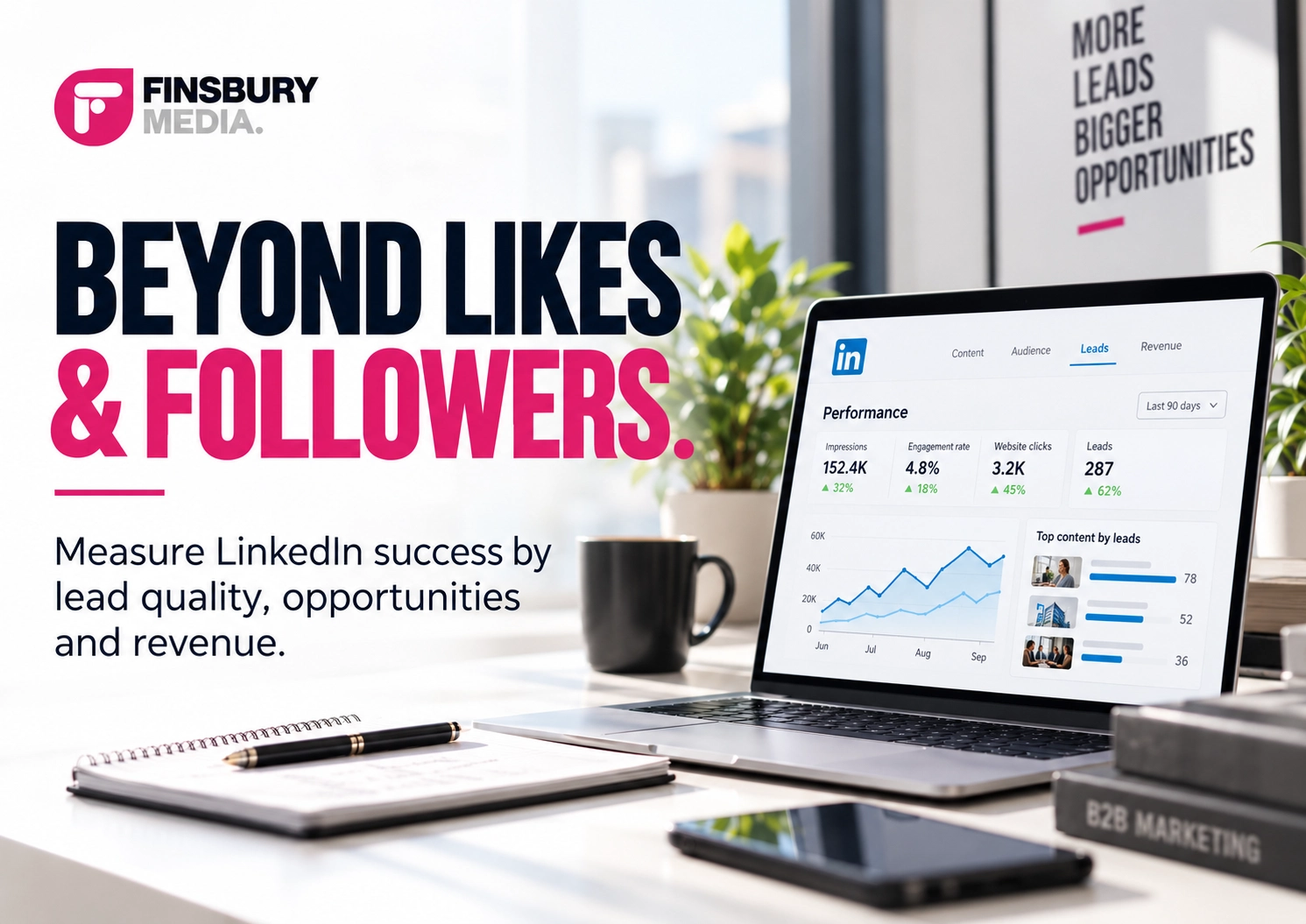
Your LinkedIn report shows more impressions, more reactions and a growing follower count. Those figures describe activity, but they do not answer the question a business owner is likely to ask: is this helping us reach potential customers and win suitable work?
For businesses investing in LinkedIn advertising services, the answer needs to connect campaign spending with outcomes. Organic activity needs clear objectives too, without pretending that every useful post should produce an immediate sales enquiry.
The starting point is to decide what each part of your LinkedIn activity is meant to achieve, then measure the next meaningful step.
Define success before opening the report
Avoid beginning with whichever metrics are easiest to export. Start with the business objective.
For an awareness campaign, you might want to introduce a specialist service to a relevant professional audience. For a lead-generation campaign, you might want enquiries from businesses with a specific need. For an established sales programme, you may want to understand which campaigns contribute to opportunities that progress.
Write the objective in terms your sales team can recognise.
“Generate more leads” leaves too much open to interpretation. A more useful internal objective might be: “Generate enquiries from UK operations managers at businesses that need outsourced facilities support.”
That definition gives you something to check when enquiries arrive. It also makes clear that a high volume of responses from unsuitable businesses would not fulfil the brief.
Keep paid and organic reporting separate
A company update, an employee’s expert commentary and a paid consultation campaign should not share one undifferentiated success measure.
For organic content, review whether you are prompting relevant conversations, attracting interest in your expertise and helping prospective customers understand your business. Look at the substance of the response, not only its quantity.
For paid campaigns, add spending and the actions associated with that spending. A report should make it possible to follow the relationship between the campaign, the response and the subsequent sales outcome.
Keep the two views connected, but distinct. An organic post may help a prospect understand your approach without directly generating an enquiry. That is different from claiming it caused a sale.
When reviewing your wider LinkedIn marketing approach, give company-page content, expert commentary and advertising their own roles before deciding what the combined programme is contributing.
Agree what counts as a qualified lead
A completed form is a response. Whether it represents a genuine commercial opportunity requires another assessment.
Define the difference between an initial enquiry, a qualified lead and a sales opportunity. Keep those definitions simple enough for the team to apply consistently.
For example, an enquiry might become qualified when the organisation fits your target market, has a relevant need and is interested in discussing it. An opportunity might require a confirmed project and an agreed next step with sales.
The criteria should reflect how your business sells. Do not label every content download as sales-ready, or change the definition halfway through the month to make a campaign look stronger.
Record why enquiries are rejected as well. “Wrong service”, “outside our market” and “no current requirement” suggest different actions. The first two might point towards targeting or messaging; the third might call for an appropriate longer-term follow-up.
Compare cost per qualified lead, not just cost per form
Consider this illustrative comparison. Both campaigns spend £1,500, and every lead is assessed using the same qualification criteria and follow-up period.
Campaign A looks cheaper when judged by initial responses. Campaign B produces twice as many qualified leads for the same advertising spend.
That does not establish which campaign produces more profit. You still need to follow those leads through meetings, proposals and sales. It does show why reducing the headline cost per lead can be the wrong objective.
Calculate cost per qualified lead by dividing advertising spend by the number of unique qualified leads. Make clear whether the figure includes advertising alone or also includes management and creative costs.
Use the same cost basis when comparing periods. Otherwise, an apparent improvement may simply reflect different accounting.
Connect advertising data with sales records
To move beyond form submissions, retain the campaign source alongside each enquiry. Record when it arrived, whether it qualified, its current sales stage and the eventual outcome.
A smaller business can begin with a carefully maintained spreadsheet. The important point is that someone owns the record and updates it consistently.
LinkedIn supports website conversion tracking through the Insight Tag, as well as imported conversions that help connect campaign activity with outcomes recorded elsewhere. Its guidance describes using website conversions to track enquiries, then importing later outcomes to understand how leads progress towards becoming customers. (LinkedIn Conversion Tracking)
Choose a setup your team can maintain accurately. Test it with a real enquiry before treating the report as reliable. Check that the enquiry reaches the right person and that its source is retained.
Understand what attribution does and does not prove
LinkedIn can attribute conversions following an ad click or an ad view, depending on the conversion setup and attribution window. The window is the period during which a subsequent action can be associated with that interaction. (LinkedIn Conversion Tracking Documentation)
A view-through conversion is therefore not the same as someone clicking an advert and immediately completing a form. Keep that distinction visible when interpreting results.
Also check how conversions are attributed across campaigns. LinkedIn’s documentation explains that some attribution settings can credit the same conversion to more than one campaign. Adding campaign totals together may therefore differ from counting unique enquiries in your sales records. (LinkedIn Conversion Attribution Documentation)
Attribution is a reporting method, not proof that advertising caused every credited sale. Avoid adding platform-reported revenue across multiple marketing channels and presenting the total as unique business revenue.
Give leads enough time to progress
Compare leads with similar amounts of follow-up time.
If your own records show that customers usually take several weeks to make a decision, this month’s new enquiries have not had the same opportunity to convert as enquiries received two months ago.
Review leads in groups based on when they arrived. Track how many qualified, how many reached a genuine opportunity and how many became customers after a comparable period.
Keep pipeline value separate from completed sales. A proposal worth £20,000 is a potential outcome, not £20,000 of revenue already earned.
Make every report lead to a decision
A useful report should explain what the team will do next.
When engagement is healthy but enquiries are unsuitable, examine the audience and the offer. When qualified leads arrive but meetings do not happen, inspect the handover and follow-up. When meetings progress but proposals fail, involve sales rather than assuming the advertising needs changing.
Businesses assessing LinkedIn advertising services should expect this connection between measurement and action. The report should help explain where progress is happening and where the process needs attention.
For a more useful view of your LinkedIn activity, speak to Finsbury Media about your objectives, your audience and the outcomes you need to understand.